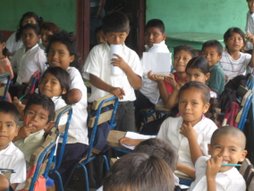
Charity, philanthropy, sustainability, community development, empowerment...Sometimes a difference in words seems to be only that, a difference in words, but after living in one of the poorest nations in the Western hemisphere where there are organizations galore wanting to address the poverty, I can't help but think that there are important distinctions in words and actions that make a huge difference in the lives of the very people that so many people in other places want to help.
Sometimes when I talk to friends and family about Opportunity International (where I'm working now), I feel like a broken record because I feel so passionate about the organization and the work that it's doing, especially here in Nicaragua. As with any job, it's not perfect and I often feel overwhelmed or insecure, but no matter how tired I feel at the end of the day, I always leave feeling in awe of the mission and the accomplishments so far. The way the organization overall attempts to "transform the lives of people in poverty" (the mission statement) is by giving micro loans to people who want to start or enhance a business. Microfinance is well-known these days; what's not as well known is that while microfinance helps people in poverty become stable, it's not actually helping much to move the poorest-of-the-poor out of poverty.
What's cool about what Opportunity International is doing in Nicaragua is that another layer of community economic development is being added, with the idea that if communities learn to work together and develop leadership/group management skills and put in plan great ideas, communities will start to move out of poverty. The reason I got involved with the library project is that a community applied for a loan to start a library, but had no experience with libraries in general, let alone managing a system of control, volunteer librarians, or accessing books. Although I am not a librarian, I have access to research tools such as the internet and educators, and thus helped develop training materials on how to create a library, in the most simplified form possible. The library is now up and running, and other communities are interested in receiving a loan to start a library. Since Opportunity has to think about sustainability, our idea is to form a network of community-owned libraries so that they can access books for really cheap prices, network with each other and already existing libraries, be treated as professionals, attend conferences, (details to follow as I am currently trying to write the policy). The great part is, EVERYTHING is community-initiated. If no other communities apply to create a library because they have other great ideas, my job will not be as applicable and I'll turn to something else where I can be of assistance or be out of a job (which wouldn't be too bad since I leave fairly soon.)
When I first was talking to Geralyn, the director of Opportunity here in Nicaragua and a strong woman who I highly respect, she told me that when she first started talking to clients in poor communities asking what they thought their communities needed, not one person thought of their own skills and talents. Instead, she heard "we need Habitat for Humanity, World Vision, Save the Children, UNICEF, (you name the organization)" to come help us. I'm not trying to put down any of those organizations, but what was striking is how dependent-sounding these communities were. So many organizations are deficit-based: children lack education, clothes, jobs food, parents don't have resources. The solution is to then fill those needs: provide education, jobs, clothes, food, resources. What if all these organizations became asset-based and focused on the skills that these communities do have? The children may lack education, but maybe they have dedicated parents who want to create a library; people may lack professional skills but are able to do construction work, run a micro business, fill out a loan. Let people come to the table with their abilities, and then provide training to help them reach a next level. Every single person I know has skills and then also has the potential to develop their skills, regardless of whether they have a Ph.D. or did not finish elementary school. Geralyn told me the key to community development work is to "never do for someone what they can do for themselves." The thing is, though, it's hard work. Sometimes really hard work.
Phew, kudos to those of you who made it through that. Why I don't like charity is that it seems to create a dependency, an "us vs. them" mentality. Maybe it's just a difference in words, but I really don't think so.
miércoles, 28 de marzo de 2007

domingo, 25 de marzo de 2007
Photos to enjoy
I don't have much to say blog-wise, but I did want to post a few more photos of the Guatemala trip, a climb on the Volcano Mombacho near Granada where I'm living now, and a few of a party I just went to. Be sure to note my favorite 90-year-old man climbing the volcano in Guatemala! I will never cease to be amazed by his endurance. I also have an album on www.kodakgallery.com that if you want to see more (read: an excessive number of) photos of various trips and adventures, let me know.
When I was younger, I had the concept that all volcanoes were pretty much the same, with the only difference being whether they were actively spewing lava or not. Well, turns out that they can be pretty different. I've done and seen quite a few now on various adventures in Central America. Sometimes they look exactly like I pictured a volcano: a mountain with smoke pouring out of the top. Sometimes there is no "top" but rather a huge crater that formed a lagoon from some big explosion a long time ago. Sometimes they are incredibly luscious with greenery, flora, fauna, animals, etc. and are more of a cloud forest, and sometimes they are barren. My favorite volcano so far has been the volcano Pacayo in Guatemala because it was the most active volcano, and probably the one that is most in accordance with my childhood image of a volcano where I actually saw red lava streaming down and red-hot lava rocks crashing from the volcano.
I've always thought that I am not a good dancer, and usually attribute my lack of dancing skills to my German/Irish/Norwegian blood ( in other words, my whiteness). Well, I'm by no means saying that I'm a fabulous dancer or that you will see me on the next up-and-coming music video, but I think I had condemned myself to not being a good dancer before, which then contributed to a tenseness that then did make me dance very stiffly. However, after having lived here in a culture where dancing is encouraged as soon as a child learns to walk (Christopher, the 2-year-old I live with, dances amazingly well for someone who still seems to have balance issues at times), and where it's incredibly easy to go out and go dancing, most frequently to salsa/cumbia/merengue/reggaeton, and where it's what people do on the weekends to relax and have fun, I've realized that it's great fun when you just learn to let go and not care what people are thinking. Plus, people are more self-absorbed that you realize, and unless you're doing something really odd (such as a 6'1" 23-year-old female dancing with a 4'5" 90-year-old male), they're not likely to be judging your dancing skills. P.S. I've met many white Europeans and Americans who dance excellently, so I'm also learning to change my stereotype. :)


domingo, 18 de marzo de 2007
A hop, skip, and a looooong bus ride to Guatemala


I love telling people that I went to Guatemala with a Nicaraguan Alcoholics Anonymous group, because (a) it's true, and (b) I am definitely not an alcoholic. Back in December, a friend I have here told me that she knows of someone who organizes a trip to Guatemala every year and that I should go along. I've heard wonderful things about Guatemala, and so I was definitely interested, but didn't think anything would come of it because I didn't even know the other family. Well, fast-forward a month or two to the end of January and I did get the chance to meet the family. Just as an example of how friendly and welcoming Central Americans can be (despite being somewhat reserved at first, as I've found with Nicaraguans), the first time I met the family, I slept over at the house (unplanned). Well, we talked more about the trip and I found out that it was a weeklong trip, including the bus ride, to Guatemala for $45 round trip, meals included. I was definitely in.
Looking back at the whirlwind of a trip to Guatemala with 50 Nicaraguans and me, the 6'1" gringa, I can't imagine a more surreal experience. I knew that we would be going by bus to Guatemala (about 15 hours away), but I was still a little surprised when a yellow school bus (fondly known as "chicken buses" by foreigners, for the chance chicken encounter) pulled up. I was directed to my seat, where once again a surprise awaited me in that I would be sharing a seat with 2 other people. Thankfully, this did not end up being the case as there was a seat with a 13 year old girl available further down the row. The bus ride itself, even with confusing the border patrol by being the only gringa in a sea of Nicaraguans, was uneventful. Well, sort of. After we had crossed the border into El Salvador at 1:30am or so, I was ready to try to at least get some rest, if not sleep. About 10 minutes after I close my eyes, scrunch down in the seat, and sprawl my legs into the aisle (they did not actually fit into the seat), the bus driver turns on Palo de Mayo music. This music is not calming in any sense. The music comes from the Atlantic Coast and is the music at clubs that people dance to by vibrating their entire body, one of the many moves that I have not yet mastered. The bus driver played this one CD over and over and over for about 2 hours and was not drowned out by earplugs or other music sadly. Needless to say, I did not get much sleep.
One day was spent in San Salvador, a big city with bustling markets and the hugest mall I have seen since coming to Central America (not comparing to the Mall of America, of course, which I know from last year, but in my opinion was nicer because it was open to the air and wound in and out). Another day was spent in Antigua, which is a colonial city similar to Granada, where I'm living in Nicaragua, but cleaner and more built-up and with more tourists. And the best bakery that I have had since coming to Central America! Good bread is incredibly hard to come by, and good whole-wheat bread, impossible. Another day we bopped around the city of Guatemala in the various markets, which are bustling and overwhelming and where you find women dressed in traditional clothing and babies strapped to their backs by a gorgeous piece of cloth. The final day, we hiked the most active volcano I've ever been on in my life.
It's funny because when people ask about my week-long trip to Guatemala, they naturally want to know what I did. While I know that it was a full week, it wasn't a tourist trip in the typical sense. I saw some sights, but I didn't see all the sights I would have planned for myself had it been a personal trip, or even a trip with other gringos. And for that reason, I absolutely love what the trip was. In the future, I'd love to come back to Central America, and Guatemala in particular, for a travel vacation because these countries are absolutely beautiful. At that time, I'll hike all over to see the ruins and the different volcanoes and the small country towns. What struck me most about this trip was the incredible generosity of everyone I met. We stayed with families in Guatemala City, that not only provided food and beds, but kindness and open arms and conversation.
There is so much more to say, but for now, I'll leave you with three of my favorite moments on the trip. (1) The AA group had a goodbye party at the home I happened to be staying, where I shed all my fears of not being able to dance by just letting go and having fun. The great thing about being a girl with salsa/cumbia/merengue style of dances is that as long as you get the basic step and hip-swinging motion down, you don't have to do much more (sorry, guys). One of the members of the AA group was this tiny, shrunken, 80-90 year old man who always wore a black sombrero. I had seen him dancing earlier in the night, but a little later, he still looked eager to dance and yet wasn't dancing with anyone. So I decided to ask him to dance, much to the hilariousness of everyone there (this man comes up to a little lower than my chest). Let me tell you, this man did NOT tire--he danced until about 12:30am, and the only reason he stopped was because I did and the party was winding down. Anyone who's ever feeling "old," whether you are 25, 40, or 80, take an example from this man. Amazing. (2) Unsurprisingly, this moment also involves this tiny old man, easily one of my favorite people. We climbed volcano Pacaya, which is the most active volcano I've ever been on. After climbing a seemingly normal moutain hike with trails and greenery, you reach a path of black lava rock, which someone told me was from an eruption in November (!). When you climb some more, everything that you're walking on is black lava rock. And when you climb even more, there is whitish black lava rock that water sizzles on because it's so hot. I actually burned my finger slightly on a rock that I thought was cool, but turned out not to be. At that point, I looked up and saw red lava falling and rocks crashing (still a great distance away). The tiny old man climbed practically all the way up, almost as far as you could go, and this was not a super-easy hike. Anytime I felt tired and out-of-breath, I just had to look at him steadily plugging along beside me, slightly ahead of me, or (rarely) slightly behind me. (3) During one of the AA sessions one night, one of the twenty-something sons of a Guatemalan AA member, took a few of us who were around the same age and also not part of AA, took an area of Guatemala City which I absolutely loved, and wished I had something similar in Granada, or knew of the area in Managua. There was a 3-block radius which the community had gotten together to build of all funky bars and restaurants, with a market in the middle. We went to a bar with lime-green couches, low red lighting, and street artists (paint street art, crystal blowing) to have juice smoothies and watch the people passing by. The perfect night.
More pictures to come later.
domingo, 25 de febrero de 2007
An ode to rocking chairs. Plus, some random pictures!
Something I've really gotten used to here and will definitely miss when I return to the US is the culture of sitting outside in rocking chairs. Every family probably has at least 4 rocking chairs, and if you walk the residential streets of Granada at night, almost all the houses you pass have families sitting outside in their rocking chairs. The other night, a friend came over and played guitar, sitting outside in the 75 degree weather in one of the rocking chairs. Although there are times when I miss having seasons to designate passing of time, I can't say I'm missing the freezing cold.
I also just wanted to post some pictures, which are from random times here in Nicaragua--mostly from when I had a stream of visitors actually. (To give some sense to what the pictures are, the people in rocking chairs are family members or friends of the family that I'm living with, the 2-year-old is Christopher who lives in the house and calls me "Tia" which means "Aunt," the people sitting around the table are the staff at Opportunity International currently, there are two of me dressed up with friends was when we went to a fancy party a few weeks ago, and the last are from when Ben visited and we went to the beach, volcanoes, and the largest island in a freshwater lake).


I also just wanted to post some pictures, which are from random times here in Nicaragua--mostly from when I had a stream of visitors actually. (To give some sense to what the pictures are, the people in rocking chairs are family members or friends of the family that I'm living with, the 2-year-old is Christopher who lives in the house and calls me "Tia" which means "Aunt," the people sitting around the table are the staff at Opportunity International currently, there are two of me dressed up with friends was when we went to a fancy party a few weeks ago, and the last are from when Ben visited and we went to the beach, volcanoes, and the largest island in a freshwater lake).


viernes, 23 de febrero de 2007
Party on, Nicaragua.
Nicaraguan parties fascinate me. No matter what event is being celebrated, be it birthday party, wedding reception, baby shower (known affectionately as "baby shower" here, not "ducha de bebe" as some of you might be thinking), or who knows what else, the party is almost exactly the same, with the only difference being that younger children's parties tend to have a piñata.
When you enter, dozens of white plastic chairs are pushed against the wall, music is blasting out of huge speakers, and after sitting in one of the chairs, you wait. The first time I went to a Nicaraguan party, I had no idea what we were waiting for, because no one was talking to each other, except for maybe awkwardly making conversation with the people they were sitting by. Well, after a little while, the host (or host's wife) and other women in the family come around with drinks on a tray for everyone in the room, which by this point may include some 40-60 people. After everyone's been served a drink, the host and family members then circle around with a plate of food for everyone. The first time this happened, I was completely amazed by the amount of preparation that goes into a party, between the guest list and the food and the decorations and the party favors.
Eventually, after the eating and the drinking, the music is turned up even louder (if possible; one of my friends has a theory that Nicaraguans are rather deaf) and the dancing/piñata bashing begins. I've always loved piñatas, and here I love them in a terrifying sort of way. The piñatas here are the largest I've ever seen in my life. For the 2-year-old's birthday in the family I've been living in, the Winnie-the-Pooh piñata was definitely much larger than he was, maybe explaining why he likes the ideas of piñatas more than the actual piñata itself. Piñatas are terrifying to me, probably because I've grown up in the US culture of lawsuits and more cautious parenting, and here, kids are whacking at piñatas very close to each other and little babies.
And the dancing. Man, can Nicaraguans dance. I'm not one of those people who claims that white people can't dance, but I have to say that dancing is ingrained in the culture here and is encouraged from day one. I tried to capture the 10-year-olds dancing in these pictures, but it's hard to capture in just a few images. "Hips don't lie," indeed. (Speaking of which, that song is a requisite in all parties, dance clubs, bars, you name it. Surprisingly, I still like the song).


viernes, 16 de febrero de 2007
An ending, but a new beginning


Photos from the last day of tutoring for Erin
Pretty much ever since I arrived here in September, I´ve been involved with two different projects: tutoring Nicaraguan first-graders in math and reading as well as helping initiate a library in a completely different, yet similarly poor and rural community. About two weeks ago, I was approached by the Director of Opportunity International, the NGO supporting this library project, and asked if I would be interested in working for the organization in Nicaragua another year as the Library Projects Coordinator. I was blown away by the opportunity, but also knew personally that I couldn´t take the job. The decision was simultaneously easy and one of the hardest decisions of my life. As a wiser and older friend here told me, ˝Whenever I´ve had decisions in my life choosing between personal and career, I´ve always chosen the personal.˝ What she said rang true with me, and also what I actually wanted. So last weekend, I mentioned to the Director that I would let her know by today about the job, but that she should know that I was definitely leaning toward not taking it. I was happy with my decision, if not a little sad that I wasn´t at the right point in my life to take it.
Well, yesterday morning, she approached me and asked if I would be interested in working until I was originally meant to leave in June. My decision was instantaneous-YES. I start work on Monday. This has meant that the past few days have been an abrupt leaving of my tutoring responsibilities, and that today was officially my last day tutoring. It was sad to say goodbye. I was no longer very excited about tutoring one-on-one, but the kids are so affectionate and really know me now that I´ve been around for about 4 months (not including vacation time during December and January). I´m including some pics I took below of my last day of school.
And so here begins, not a new adventure exactly, but a different one. I feel daunted and intimidated by the work that lays ahead, but also incredibly excited.
jueves, 15 de febrero de 2007
Library inauguration!


(To the left, Biblioteca "Quiero Aprender Contigo" (TOP), Inauguration crowd (MIDDLE), Director of Opportunity International receives gift (BOTTOM)
Yesterday, Biblioteca "Quiero Aprender Contigo" celebrated Valentine's Day** with an inauguration ceremony. Yes, the library is officially open! In October, I gave a training to a group of community members on the functions of a library. Now, there is a functioning Board of Directors (Nicaraguan style, so for the most part), volunteer librarians, a painting class that is going to start this Sunday, and an open library with about 150 beautiful books. (Check out www.aprendercontigo.org for information on how to donate books). Despite roasting under the hot Nicaraguan sun, the ceremony was fabulous and professional. In fact, it was the gringos who were late in coming. A poem by Ruben Dario (the famous poet of Nicaragua), folkloric dancing, an official presentation of a check from the local microfinance trust bank, refreshments at the end--what more could I want?
 **Happy Valentine's Day, belatedly! Here Valentine's Day is known as "Dia de la Amistad y Amor," which translates to "Day of Friendship and Love." I'm particularly fond of that name for it because it doesn't seem to be just about romantic relationships, which can make people bitter/melancholy if they aren't in a romantic relationship (or if their boyfriend/girlfriend is far away in another country, I suppose...). Here the Nicaraguan tradition is to go out and dance. I didn't participate, but there might have to be a make-up day this Friday.
(To the left, the President of the Board of Directors, Eva Maria Davila, on the left, lets Helen Rorengold of the private library in Granada speak)
Suscribirse a:
Entradas (Atom)